FlyingPress vs WP Rocket: Best WordPress Speed Plugin


You’re looking for the best plugin to speed up your WordPress site? The FlyingPress vs WP Rocket showdown is hard to skip. Both premium cache extensions are top-tier on speed, simplicity and Core Web Vitals optimization.
So which one should you pick? In short:
- Pick FlyingPress if: you want an all-in-one solution that performs out of the box, with a modern interface and a laser focus on Core Web Vitals. It’s the install-and-forget option for immediate speed gains.
- Pick WP Rocket if: you need finer-grained settings, built-in database optimization, or proven compatibility across thousands of setups including multisite.
This guide helps you cut through the noise and make the right call for your project.
Feature comparison: FlyingPress vs WP Rocket
Let’s dig into the details to see what each plugin has under the hood.
Loading optimization and Core Web Vitals
This is where the real work happens. To improve your PageSpeed scores and Core Web Vitals, both plugins use similar techniques:
- CSS and JavaScript minification.
- Deferred script loading (Delay JS) and lazy-loaded media.
- Link preloading and Google Fonts preloading.
A key feature is Remove Unused CSS. Both plugins offer it and it matters for improving LCP (Largest Contentful Paint) and reducing CLS (Cumulative Layout Shift). On an Elementor page for example, it loads only the styles for the widgets you actually use, which trims the page weight significantly.
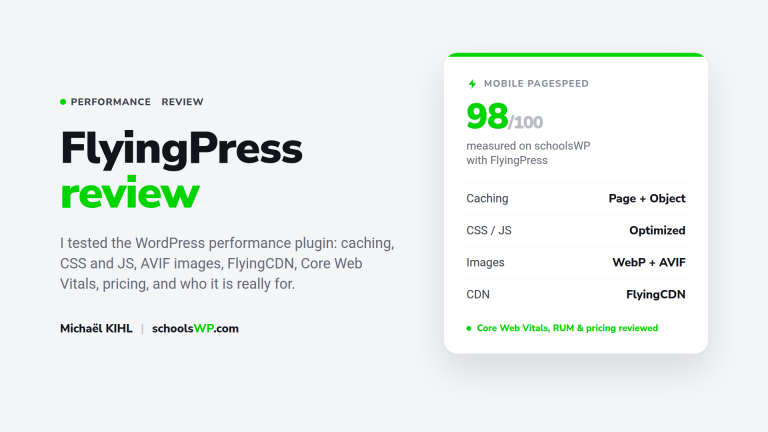
FlyingPress usually has the edge on simplicity to hit excellent default scores, thanks to smart preloading based on your most visited pages.
Advanced caching and compatibility
Both plugins handle page caching well, with options to exclude URLs, preload the cache and integrate a CDN.
Key compatibility notes:
- Hosts: both plugins run on most hosts. Watch out if your host ships its own optimization tool (like SiteGround Optimizer). Avoid enabling the same options twice (page caching for example) to prevent conflicts.
- Cloudflare: you can run FlyingPress and WP Rocket with Cloudflare, including with APO. Configure purge and exclusion rules carefully and everything works together.
- Compression: WP Rocket can add rules to enable server-side compression (GZIP/Brotli), but the actual work is done by your host or CDN. The plugin itself does not compress files.
WP Rocket, in use on more than 3 million sites, has a reputation for rock-solid stability and compatibility, especially with complex plugins like WooCommerce or Elementor.
Image optimization
Heads up, this one is often misunderstood. Neither FlyingPress nor WP Rocket compresses your images or converts them to WebP *natively* in the base plugin. They mostly handle loading:
- Lazy Loading: both plugins load images, iframes and videos only when they enter the viewport.
- YouTube preview: both can replace a YouTube video with a clickable thumbnail, which avoids loading the full player script on page load.
For compression and WebP conversion:
- WP Rocket integrates cleanly with Imagify (built by the same team) to automate compression and conversion.
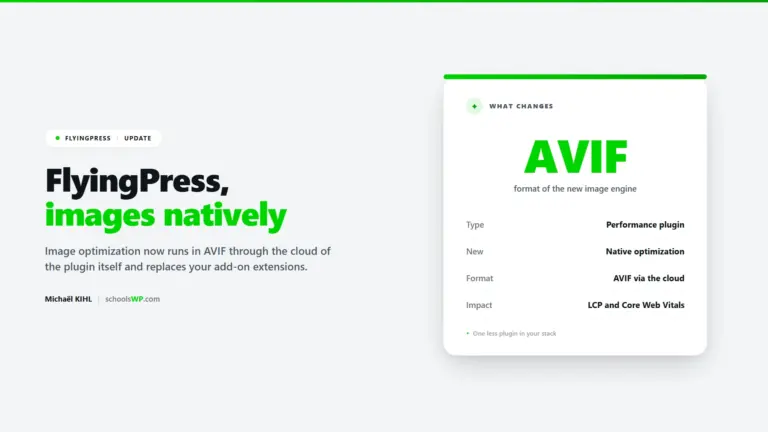
- FlyingPress offers this optimization via its add-on FlyingCDN, which optimizes images on the fly.
Database and scripts
Here the edge goes to WP Rocket. It ships a complete module to clean and optimize your WordPress database: removing post revisions, drafts, spam comments and more.
FlyingPress focuses on the front-end and does not offer this feature. You’ll need a dedicated plugin like WP-Optimize if you go with FlyingPress and want to clean your database.
Interface and setup
Both plugins are known for their ease of use, with clean interfaces and quick setup.
Good news: unlike its early days, FlyingPress is now fully localized, just like WP Rocket. Language is no longer a deciding factor. WP Rocket keeps a slight edge with a more extensive knowledge base and historically stronger localized support.
Pricing: Which one offers better value?
Both plugins are paid with an annual subscription. Here is a pricing snapshot (rates can change, always double-check on the official site).
| Plugin | Annual price (1 site) | Free version? | Refund |
|---|---|---|---|
| FlyingPress | $49 ($42 renewal) | ❌ No free version | ✅ 14 days |
| WP Rocket | 59 $ | ❌ No free version | ✅ 14 days |
Bottom line:
- For 1 site, the price is usually the same ($59/year).
- For multiple sites, FlyingPress quickly becomes more economical with its tiered plans (10, 100, 500 sites).
- WP Rocket offers an unlimited license, which can be a decisive advantage for agencies or freelancers running many sites.
Factor in the extra costs if you need them: Imagify for WP Rocket, or FlyingCDN for FlyingPress if you want their image optimization solution.
Pros and Cons: Head to Head
✅ FlyingPress strengths
- Very modern and intuitive interface.
- Excellent default performance, especially on Core Web Vitals.
- All-in-one solution that avoids installing several other plugins.
- Strong value for money on multi-site licenses.
- Smart optimization (popular pages preloading for example).
❌ FlyingPress weaknesses
- No built-in database cleanup feature.
- No free version to try (but a money-back guarantee covers you).
- Fewer fine-grained configuration options than WP Rocket.
✅ WP Rocket strengths
- Full localized interface and support.
- Database optimization feature included.
- More configuration options for granular control.
- Very large community and proven compatibility.
- Unlimited-site license available.
❌ WP Rocket weaknesses
- Sometimes requires more tweaks to match FlyingPress default performance.
- Image optimization requires buying Imagify separately.
- Slightly more expensive when comparing licenses for many sites (outside the unlimited license).
What are the alternatives?
If neither works for you, here are other options to consider:
- LiteSpeed Cache: free and powerful, but only works optimally on a LiteSpeed server.
- W3 Total Cache: very complete and configurable, but its interface can be intimidating for beginners.
- Perfmatters: not a cache plugin, but an excellent companion to disable unused scripts and slim down WordPress. It works very well alongside WP Rocket or FlyingPress.
- NitroPack: an all-in-one SaaS solution that performs well, but more expensive and takes control of your optimization.
Questions about FlyingPress vs WP Rocket? I have the answers for you.
Get answers to a list of the most Frequently Asked Questions.
Verdict: FlyingPress or WP Rocket?
The choice between FlyingPress and WP Rocket really depends on your needs and technical level.
My verdict: for most users who want maximum speed gains with minimum work, FlyingPress is the best choice today. It’s a modern solution, highly effective right after activation, and it nails the metrics Google looks at (Core Web Vitals).
WP Rocket remains a safe bet and an excellent plugin, especially if you’re an advanced user who wants control over every detail, if you need built-in database optimization, or if you manage a fleet of sites with the unlimited license.
Still on the fence? Both plugins offer a 14-day money-back guarantee. The best way to know is to test on your own site!