ClickFunnels Review (2026): Is It Really Worth the Price and Hype?


If you have ever tried selling anything online, you know that the traditional website model can sometimes feel like a sieve. Visitors land on your homepage, get distracted by dozens of links, blog posts, and menus, and leave without buying anything. That is where sales funnels come in, and more specifically, ClickFunnels.
If you use these links to purchase a service, schoolsWP receives a commission at no additional cost to you. Our reviews remain 100% independent and are based on real tests.
But does this famous SaaS platform live up to its marketing promises in 2026? Is it really the best option for your business, or should you look at more integrated alternatives? In this honest ClickFunnels review, we will break down the features, pricing, pros and cons, and show you some incredible WordPress-native alternatives that might suit you better.
Is ClickFunnels the absolute best platform for managing your marketing, or are you paying too much for features you could host yourself? Let’s analyze the data.
What is ClickFunnels and How Does It Work?
ClickFunnels is a SaaS (Software as a Service) platform designed to simplify the creation of sales funnels. Instead of building a classic website where visitors browse freely, ClickFunnels directs visitors down a highly structured path. This path, known as a funnel, has one goal: conversion.
Launched in 2014 by Russell Brunson, ClickFunnels has evolved significantly, especially with the release of ClickFunnels 2.0. The software integrates landing page builders, shopping carts, email marketing autoresponders, member areas, and analytics into a single dashboard. It offers a complete online business suite in one subscription, removing the need to connect multiple plugins or platforms together.
Why Do You Need a Sales Funnel (and Why Websites Fail)?
Many business owners believe that having a beautiful website is enough to generate sales. Unfortunately, the opposite is often true. Traditional websites present visitors with too many choices: they can read your about page, check your latest blog posts, look at different services, or follow your social media links. Every option represents a potential exit point where a visitor can leave without sharing their contact details or buying a product.
In contrast, a dedicated sales funnel is designed to guide a user through a single, logical sequence of steps. Conversion rates on sales funnels are often three to four times higher than those of traditional homepages.
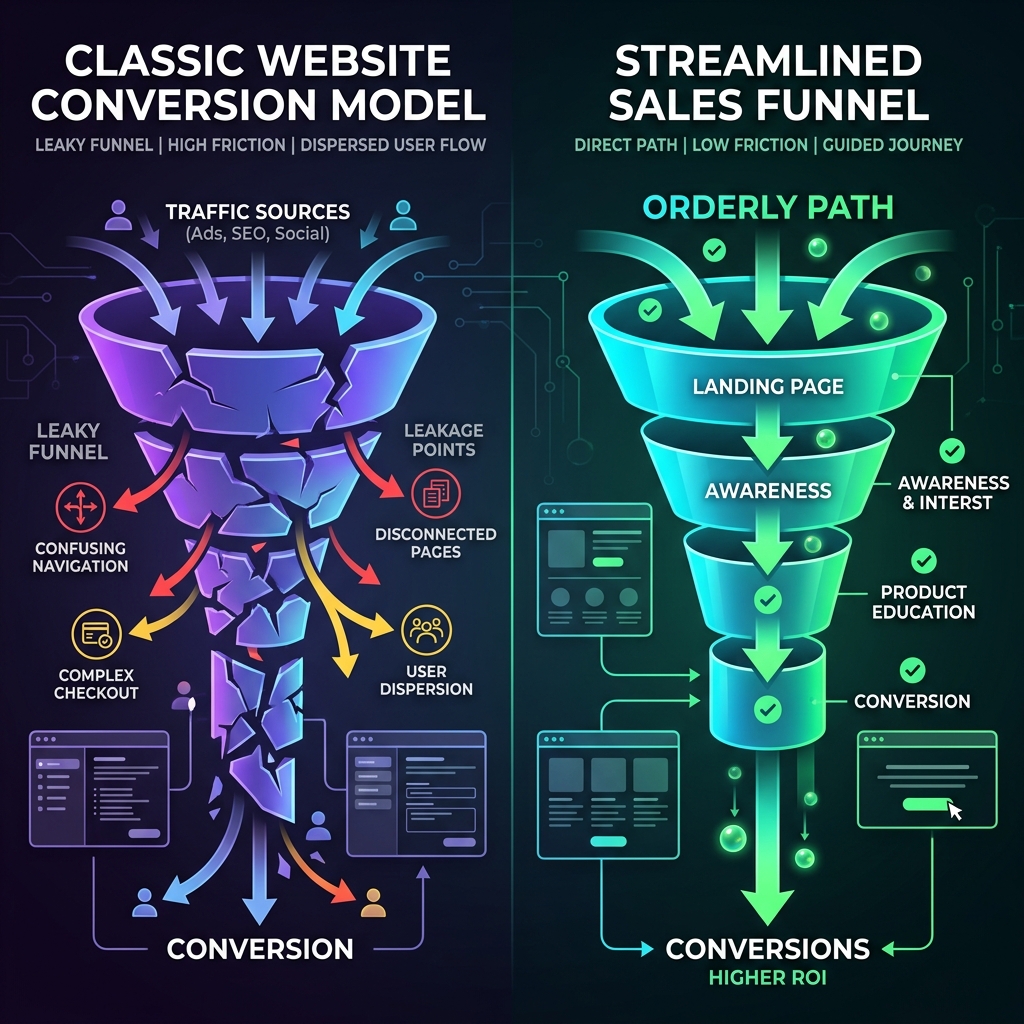
A typical funnel follows this path:
- The Lead Magnet (Squeeze Page): Offers a free resource (like a PDF guide or checklist) in exchange for an email address.
- The Sales Page: Showcases your main offer with copy, testimonials, and video.
- The Checkout & Order Bump: Allows secure payment while offering a quick add-on product at checkout.
- One-Time Offers (OTOs): Presents upsells and downsells immediately after the purchase to increase average order value.
- The Thank You Page: Confirms the order and outlines next steps.
ClickFunnels Key Features Under the Microscope
To understand if ClickFunnels is worth the investment, we need to inspect the core features that form the backbone of the platform.
1. Drag-and-Drop Page Builder & Editor
The core of ClickFunnels is its visual page editor. It uses a grid system of sections, rows, and elements that you can easily move, customize, and edit. You do not need to write a single line of code to change fonts, upload images, embed videos, or add form fields. While the interface is easy to use, it does have a learning curve if you are transitioning from other builders.
2. High-Converting Funnel Templates
ClickFunnels provides a database of pre-built funnel templates. These templates are grouped by goal: generating leads, selling a product, hosting a webinar, or running a membership site. They have been tested across various niches and are designed to convert visitors right out of the box. You simply pick a template, swap the text and branding elements, and go live.
3. Email Marketing & Workflows
Instead of connecting a third-party email provider like Mailchimp or ActiveCampaign, ClickFunnels includes its own automation engine. You can create sequences based on user behavior (e.g., if a user buys a product, send email A; if they abandon the cart, send email B). You can also tag contacts and segment lists directly inside the platform.
4. Sales Tracking & Detailed Analytics
To run campaigns effectively, tracking is mandatory. ClickFunnels provides a dashboard showing your visitor numbers, opt-in rates, click-through rates, and average cart value. You can easily set up A/B split testing to compare two versions of a landing page and see which one generates more revenue.
ClickFunnels Pricing Plans in 2026: Is It Worth the Cost?
One of the main criticisms of ClickFunnels is the price. As a premium SaaS platform, it requires a significant monthly investment. Let’s look at the standard plans:
| Feature | Basic Plan | Pro Plan | FunnelBuilder Plan |
|---|---|---|---|
| Monthly Price | $147 / month | $197 / month | $297 / month |
| Funnels | 20 funnels | 100 funnels | Unlimited |
| Pages | 100 pages | Unlimited | Unlimited |
| Admin Users | 1 user | 5 users | 15 users |
| Domains | 3 domains | 9 domains | 9 domains |
| Contacts | 10,000 | 25,000 | Unlimited |
While the feature set is extensive, the starting price of $147/month is high for beginners. If you are just starting your business or testing a new offer, paying nearly $1,800 annually for a funnel builder can be a heavy burden on your budget.
The Pros and Cons of ClickFunnels
To help you decide, let’s summarize the key advantages and drawbacks of the platform:
- Pros:
- All-in-one suite: pages, checkout, email automation, and members area.
- Fast deployment with high-quality, pre-built templates.
- Built-in split testing and detailed analytics.
- Active and supportive community.
- Cons:
- Very expensive starting price ($147/month).
- Data ownership limits: if you cancel your subscription, you lose all your pages and funnels.
- Less flexible than a WordPress-native setup for customization.
- Can feel bloated if you only need landing pages.
Why WordPress is the Ultimate ClickFunnels Alternative
If you already run a WordPress site, you do not need to pay $147/month to build high-converting sales funnels. The WordPress ecosystem offers outstanding, native tools that turn your existing site into a powerful sales engine at a fraction of the cost.
By hosting your funnels on WordPress, you maintain complete ownership of your data, pay no monthly SaaS fees, and integrate seamlessly with WooCommerce. Let’s look at the two best WordPress funnel builders:
1. FunnelKit (Formerly WooFunnels)
FunnelKit is arguably the most powerful WordPress alternative to ClickFunnels. It integrates directly with WooCommerce and allows you to create opt-in pages, opt-in popups, checkouts, one-click upsells, and thank you pages. FunnelKit also includes FunnelKit Automations, which handles email marketing, abandoned cart recovery, and customer segmentation right from WordPress.
2. WP Funnels
WP Funnels is a user-friendly drag-and-drop funnel builder for WordPress. It offers a visual canvas where you can map out your steps (landing page, checkout, upsell, downsell, thank you) and see the entire journey at a glance. It integrates with popular page builders like Elementor, Gutenberg, and Divi, making page creation incredibly smooth.
Comparison: ClickFunnels vs. WordPress Native
| Criterion | ClickFunnels | WordPress Native (FunnelKit / WP Funnels) |
|---|---|---|
| Hosting & Control | SaaS (Hosted by ClickFunnels) | Self-Hosted (You own 100% of your site) |
| Annual Cost | From $1,764 / year | ~$200 - $300 / year (plugins + hosting) |
| Design Flexibility | Restricted to ClickFunnels builder | Use Gutenberg, Elementor, Divi, Kadence |
| Data Security | Locked in SaaS database | Full control over your customer database |
| WooCommerce | Requires complex Webhooks | Native, deep integration with WooCommerce |
FAQ: Common Questions About ClickFunnels
Can I use ClickFunnels with my WordPress site?
Yes, ClickFunnels offers a dedicated WordPress integration plugin. This plugin allows you to embed your ClickFunnels pages directly onto your WordPress URLs. However, the page is still hosted on ClickFunnels servers, meaning you are still dependent on their system and subscription.
What is the difference between ClickFunnels 1.0 and 2.0?
ClickFunnels 2.0 was rebuilt from the ground up to address speed issues and add features like team collaboration, site-wide design settings, dynamic checkout options, and a visual workflow editor. While it is faster, it is also more complex and expensive.
Is there a free trial for ClickFunnels?
Yes, ClickFunnels offers a standard 14-day free trial. You must provide credit card details to access the trial, and you will be billed automatically if you do not cancel before the 14 days expire.
Final Verdict: Should You Buy ClickFunnels?
ClickFunnels is a powerful marketing tool if you want an all-in-one SaaS platform and do not want to manage hosting, security, or updates. It is highly suited for entrepreneurs who have a budget to spend and value speed over complete platform ownership.
However, if you already use WordPress, paying $147/month for ClickFunnels makes very little sense. WordPress plugins like **FunnelKit** or **WP Funnels** give you the exact same features (squeeze pages, custom checkouts, order bumps, one-click upsells, automated email marketing) at a fraction of the cost, while keeping you in full control of your website and customer database.